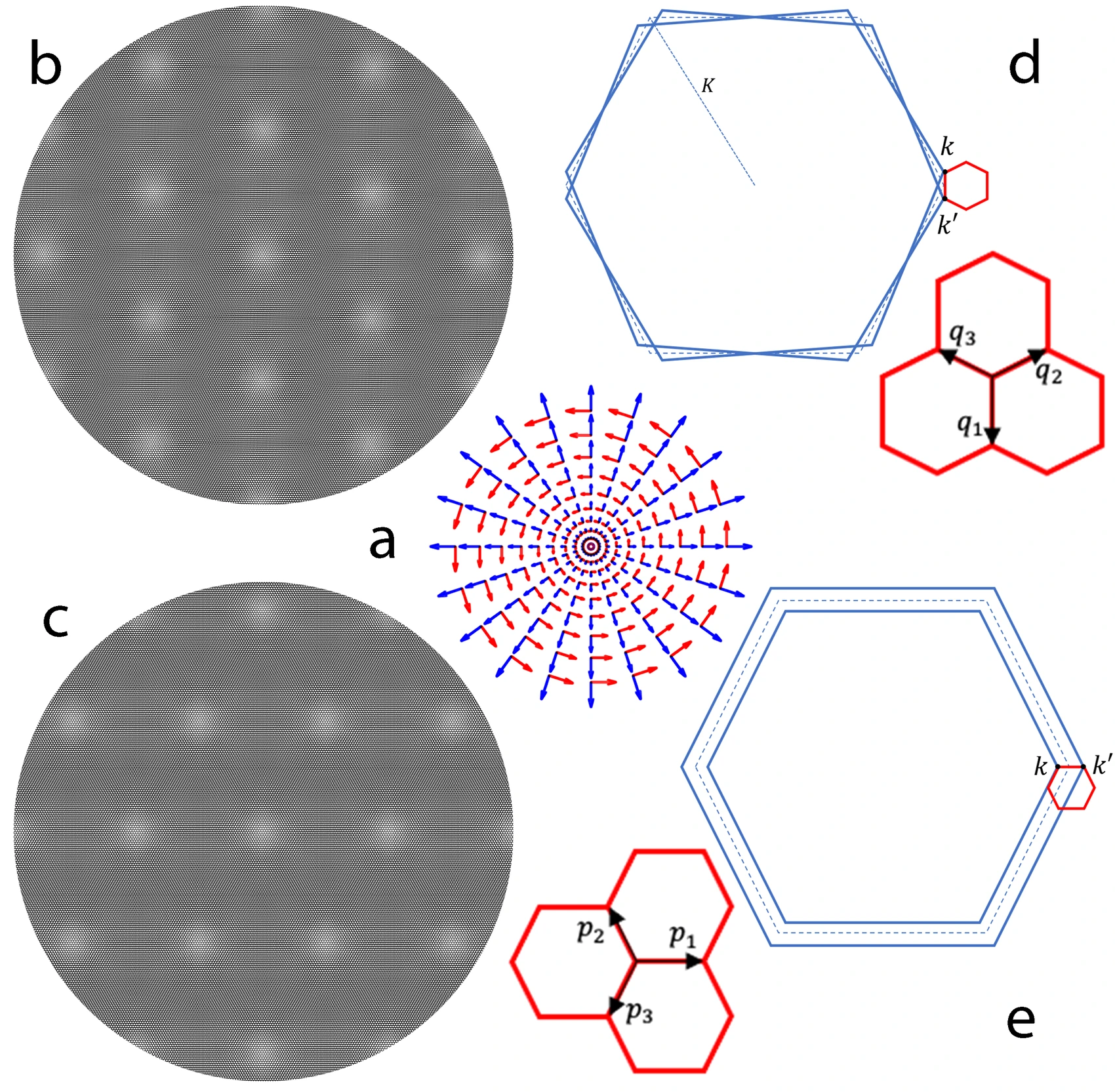
Lay two grids over each other and a third pattern appears, far larger than either. That is all a moiré is. This Letter takes the idea seriously enough to ask what the minimum equipment for it is — and finds that the answer involves no lattice, no quantum mechanics, and no particular number of dimensions. Two smooth geometries, one a rescaling of the other, will do.
It opens on solid ground and ends somewhere speculative, and it says so. The first half is about graphene: that a uniform stretch of one layer produces the same physics as a twist, magic scales included. The second half asks whether the same arithmetic could make the cosmological constant small, and offers a toy model, marked as one.
The page below runs in two registers. Read it as a reader, as a physicist, or with both columns side by side.
Two flows, one pattern
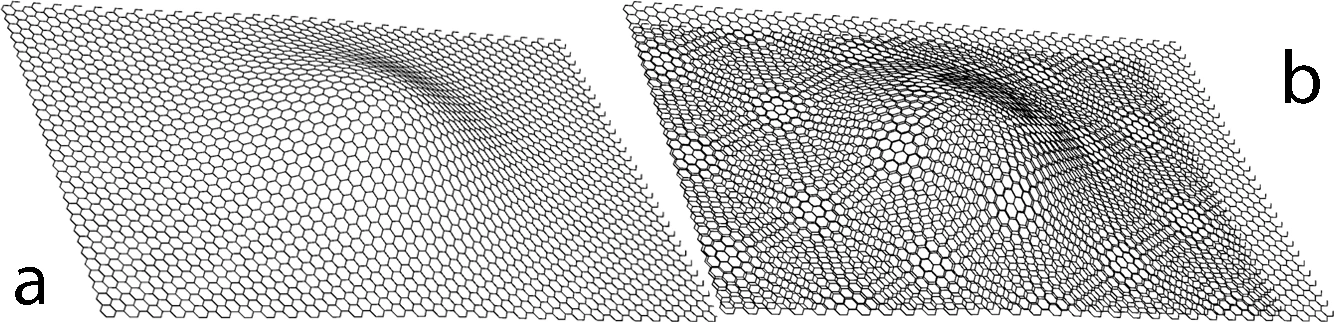
A bilayer is made by deforming one sheet relative to the other. Twisting is one way. Stretching — pulling one layer uniformly bigger in every direction — is another, and it had been treated as the awkward relative rather than the twin.
The two deformations are exactly perpendicular, as vector fields. So the patterns they make are the same pattern, turned through ninety degrees.
A general deformation of one layer is the two-dimensional diffeomorphism . Twist and uniform biaxial strain are the two simplest flows, and they are orthogonal:
Deform one layer by and the other by and the two moiré patterns are ninety-degree rotations of each other, in real space and in the Brillouin zone alike.
So the stretch has magic scales too
Twisted bilayer graphene has magic angles: particular twists at which the electrons stop moving and the band goes flat. If the stretch is really the same move rotated, it should have magic scales as well.
It does. The condition is that the interlayer tunnelling matrix be related to the twisted one by that same right-angle rotation — and if it is not, there is no reason for a flat band to appear at all.
The tunnelling matrix of the strained bilayer is a quarter turn of the twisted one, acting on the argument and on the spinor indices together:
Given that relation, the known numerical and analytic arguments for magic angles carry across, and the renormalized Fermi velocity at K vanishes at . If the tunnelling matrix does not satisfy the relation, flat bands would not necessarily appear.
Eqs. (2)–(3)
Written geometrically
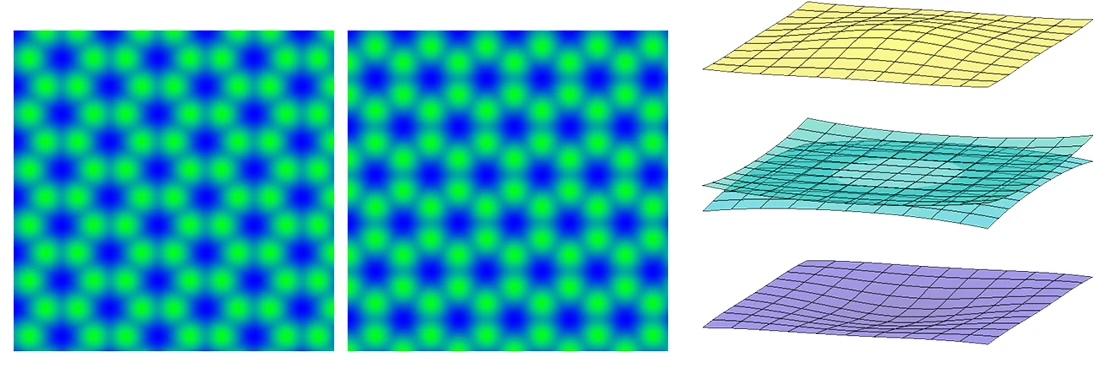
Deforming a sheet is the same as changing the ruler you measure it with. So the natural language for a deformed bilayer is not lattices but geometry: each layer carries its own metric, and an electron hops between them.
The Letter writes the bilayer Hamiltonian in exactly that form. Once it is written that way, the electron is tunnelling between two curved spacetimes, and the interlayer hop plays the part of a passage between them.
With the vielbeins of each deformed layer and :
The strain-induced gauge field is with . Curvature of the sheet adds a second one, , through the varying angle between -orbitals, with for graphene.
The theory is then fermions tunnelling between geometries , the interlayer tunnelling playing the role of a wormhole process — with the Letter’s own caveat that no Einstein–Rosen bridge is meant, and that the metric here is not dynamical.
Eqs. (4)–(7)
What a moiré actually requires
Here is where the paper turns. Having written the bilayer as geometry, one can ask what was really needed to make the large scale appear — and the answer is much less than a crystal.
No lattice. Two continuum theories will do it, even random ones. And nothing in the argument cares how many dimensions there are.
Moiré physics is defined here as the emergence of new length or energy scales, much larger or smaller than those of the individual systems, when two systems are superimposed. From the geometric form the conditions are: two smooth manifolds of arbitrary dimension, overlapping or coupled, with the metric of one a scaling diffeomorphism of the other. Neither an underlying lattice nor quantum mechanics enters the requirement.
Try it on gravity
If two overlapping geometries make a small scale out of two large ones, and the cosmological constant is a small scale that theory insists should be enormous, the arithmetic is at least worth writing down.
So: two copies of general relativity, each with its own huge cosmological constant, coupled to each other in the only way two geometries can be coupled without either one lending the other a ruler — through a shared volume element.
Take two Einstein–Hilbert actions with metrics and and constants , , and couple them purely geometrically:
This crossbreed determinant transforms exactly as a metric determinant does, so the coupling is diffeomorphism invariant; for conformally flat metrics it reduces to . The two universes are coupled through a shared volume element and nothing else.
Eqs. (9)–(11)
What comes out
Solve it for the simplest expanding universes and a condition appears: the two can only coexist if their cosmological constants are related in a particular way. What gravitates, in the end, is not either constant but a combination of them, divided by the difference between the two universes’ volumes.
A difference of two nearly equal huge numbers can be as small as you please. The two constants in the action are set by the scale of the theory. The one that survives is set by the constants of integration, which are not.
With the FLRW ansatz , the solutions are and likewise for , and a solution exists if and only if a consistency relation between the two s holds. Setting the two effective constants equal:
with the spacetime volume elements of each universe. The magnitudes of , and appear in the action and are set by the scale of the theory — order , or zero. depends only on the constants of integration, and can be chosen arbitrarily small.
Eqs. (13)–(22)
And a history
Run the other way, the same equations give a story rather than a number. Start the two universes badly out of step, with large cosmological constants of opposite sign. They pull towards each other, and as they come into step their individual constants fall to nothing.
Choosing and with ,
Two universes that begin far from equilibrium with sizeable cosmological constants, one negative and one positive, approaching equilibrium as their isolated constants vanish.
Eq. (23)
How far this goes
The graphene half is established physics. The gravity half is an explicit toy model, and the Letter presents it as one — a construction that is not unique, and a speculation about relevance rather than a claim of it.
What it does establish is narrower and firmer: that the mechanism which makes a large pattern out of two small ones is geometric, not crystalline, and that nothing stops one from writing it down for spacetimes.
The Letter states the status of the second half directly: the toy model of moiré gravity is not unique, other setups with different mechanisms of overlapping geometries can be constructed, and the relevance to the vacuum catastrophe is offered as speculation. The follow-up, Moiré Gravity and Cosmology, is where the construction is developed into a dynamical field.