Is there a two-dimensional membrane — a smooth surface described by a height function, sitting in ordinary three-dimensional space — on which Brownian motion is transient?
The question is not idle. A great many familiar results in two dimensions come from a single fact about the Laplace–Beltrami operator: its Green’s function diverges. In the flat plane the divergence is logarithmic, which is exactly the borderline. Push the space over that line and the results that lean on it stop holding.
Hyperbolic spaces are transient, and have been studied for exactly this reason. But the hyperbolic plane cannot be embedded in flat three-dimensional space as a surface, so it is not something a material could be. The question here is whether a real surface can do it.
Not if it is round
A rotationally symmetric membrane is always recurrent. There is no choosing a clever profile.
This is the first thing the Letter establishes, and it is a genuine obstruction rather than a difficulty. Write the induced metric of a height function over the plane and demand rotational symmetry, and the radial part of the metric is always larger than the flat one — the surface is longer in the radial direction than the coordinate suggests, because it goes up and down on the way. The transience integral then has no chance of converging.
For , transience is equivalent to . The induced metric of a membrane is
which under rotational symmetry becomes with . In terms of physical radial distance the transience condition reads , and that needs . But always. Transience on a membrane is unachievable with rotational symmetry.
Eqs. (2)–(10) · equation numbers throughout are those of arXiv:2503.07705v2
A criterion that survives losing the symmetry
Dropping rotational symmetry means the standard criterion no longer applies, and the obvious generalisation is wrong — as a paraboloid demonstrates: its volume grows fast enough by the naive test, and yet a walker on it comes back, because the coordinate radius is not the distance anyone actually travels.
The Letter proves the right version. The picture behind it is a resistor network: cut the surface into thin wedges, work out the resistance of each one out to infinity, and add the conductances. If the total is not zero, current flows away — and so does the walker. What matters is that the resistance is computed along physical distance, which is where the naive test went wrong.
For a smooth metric in polar-like coordinates with ,
The surface only has to look transient on a set of directions of positive measure — a wedge is enough. The resistance of a wedge of angle is its physical length over its physical cross-section, which gives the integrand above; summing the reciprocals over gives a non-zero conductance exactly when the condition holds. A formal proof by capacity is in the Supplemental Material. The rotationally symmetric case falls out again: , , , so the integral is at least .
Eqs. (11)–(12)
The tablecloth
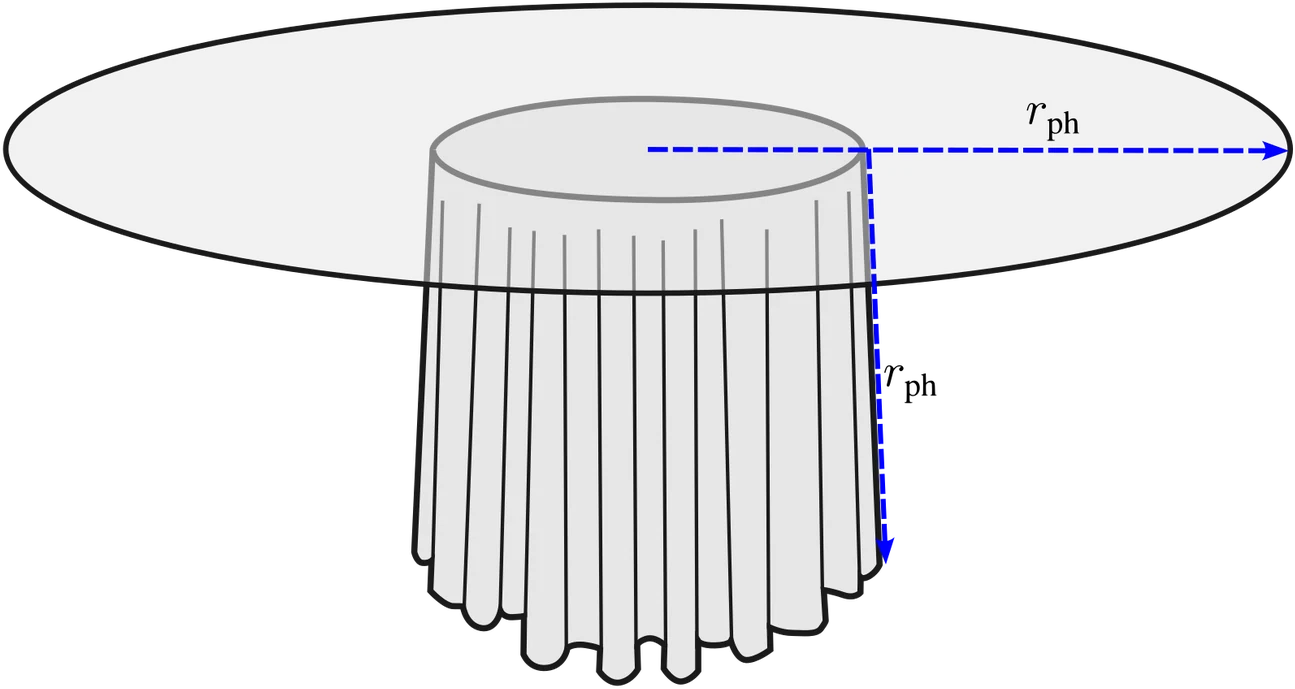
A cloth laid on a round table has to wrinkle, because there is more cloth than there is table. Wrinkle it fast enough and a walker never comes back.
The construction is annuli. In each ring the surface ripples around the circle, and the rings further out ripple faster: the th ring, at radius about , oscillates with angular frequency . The height never exceeds one. The radial distance stays proportional to the coordinate, because the ripples are angular. And the area grows very fast, because the ripples put a great deal of surface into a small ring.
Between the rings there are thin flat bands where the surface is exactly the plane. Those are what make the curvature bookkeeping clean: by Gauss–Bonnet, the total curvature inside any ball ending on a flat ring is exactly zero. So the surface is flat on average and transient anyway — the negative-curvature patches win without needing a net.
with a smooth bump supported on , equal to one on most of that interval — so only one term contributes at any radius. Where the metric is simply . On balls ending at , where the surface is flat,
The transience condition then reduces to the convergence of
whose terms fall like except where is near a multiple of , when they behave like — which would diverge. That the bad cases are rare enough is settled by equidistribution of , with the Erdős–Turán inequality supplying the rate: the sum converges for almost every , which is more than the criterion asks for.
Eqs. (13)–(16)
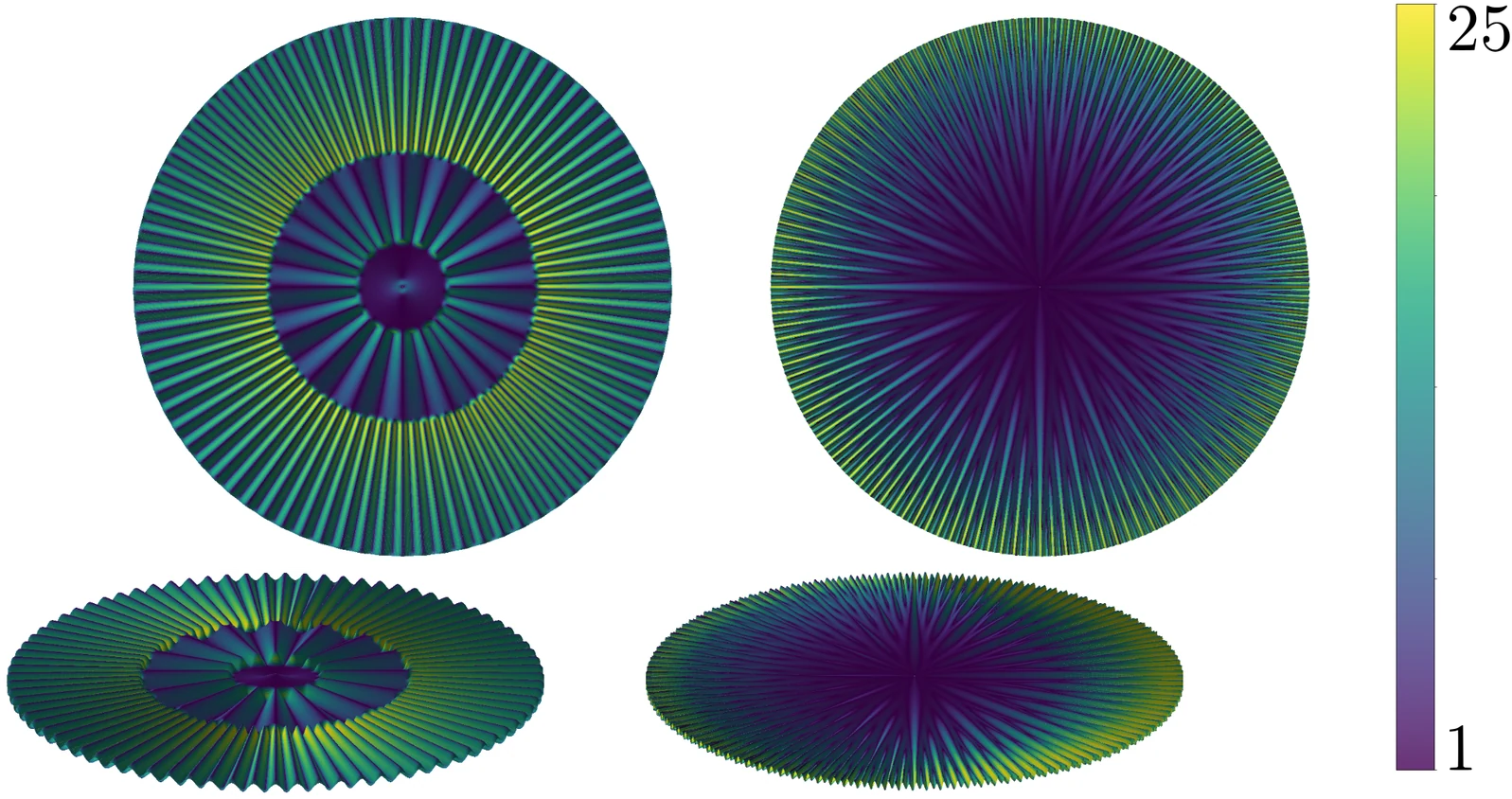
How delicate it is
Fast area growth is not sufficient, and the Letter is careful to show it. Change the bumps so that each plateau has length one instead of length and the surface grows in area faster — and the transience integral now diverges for every direction. The reason is the flat rings: spaced evenly in radius, they contribute over evenly spaced intervals, which diverges. Generic tablecloths, with no flat rings at all, are expected to be transient.
There is also a thread back to cosmology. A space that is flat on average but patched with curvature of both signs, behaving hyperbolically because the negative patches win, is Zeldovich’s “universe homogeneous in the mean” — the same intermittency argument, on a membrane.
Because the tablecloths are so inhomogeneous, the usual scaling and arguments for Anderson localization — which assume homogeneity — do not apply to them at all.
What it would be made of
Corrugated two-dimensional materials, rough substrates, circuit-based simulators. The Letter names curved bilayer systems as a place to look, which is where its authors’ other work lives — a bilayer with a deformation is already a problem about a surface with a metric.